
We spend most of our waking hours at work, and there’s no doubt that our work environment can have a huge influence on our health, both for the better and for the worse.
In many regards, when leading a team it’s useful to lead by example. Taking care of our health is no exception.
If our team sees us implementing strategies to take care of ourselves, they are welcomed to do the same for themselves.
So, where to start? Ultimately, this is up to you. Choosing something you resonate with to start working on first is helpful in building momentum. Here are six ideas to choose from to get you started.
Set boundaries
In a work environment, many of us find it difficult to stick to good habits because we are trying to meet the expectations of our colleagues and our employers. But sometimes these expectations haven’t been clearly communicated. We can often presume that something is an expectation, without asking and without attempting to prioritise our own goals.
If you want to take your lunch break between 1 – 2pm and your colleague asks to run a meeting at 1pm, it’s easy to presume that they expect you to work through your lunch, or change your lunch break, so you do. In that situation, you haven’t articulated your boundaries around lunch or set their expectations.
Most people are pretty good at adapting to the boundaries we create, as long as you set clear expectations for them. If you want to make sure that you have a lunch break you will need to set that expectation. So, when someone wants to meet at 1 o’clock, you need to say: “I’ll be at lunch at that time, can we make it 1:30pm or another time.”
Some boundaries which can be helpful for health:
- Taking a lunch break
- Eating snacks and lunch away from your desk
- Having a limit on the number of coffees/treats/meals you buy in a week
- Taking time to exercise before/after work
- Managing how much time you spend sitting.
I’m not saying you should refuse to do anything that doesn’t fit your exact plans. In a workplace you often have to be flexible. However, articulating your boundaries sets expectations for others to work with and you may be surprised with how quickly they adapt.
Similarly, if someone articulates their boundary to you, respect it. If they say “No, thank you” to a TimTam, trust that they are making the right decision for them and move on.
This is where leading by example can really shine. By setting your own boundaries you are giving your team members permission to do the same for themselves. Setting and negotiating clear boundaries can help your whole team uphold their health goals while creating a positive culture of health within your team. Here are some things you can implement:
- Giving staff a set time for their lunch break
- Set an example of not working through the lunch break
- Make it a policy not to have meetings within the lunch time frame
- Set expectations for start and finish times and clearly communicate when those expectations need to change
- Be open about your own boundaries
- Ask your team members what they’d like their boundaries to be. Be honest about how that will affect the team and if it won’t work, try to negotiate an alternative.
Take a microbreak
I’m a big believer in the accumulation of marginal gains.
Small actions done on a consistent basis can be just as, if not more, effective than a big effort on occasion.
Take breaking up the amount of time you spend sitting, for example. If you walk to a toilet in a different area of your building, that might mean 400 steps instead of 100. While 300 steps won’t mean much on one occasion, if you take a microbreak every hour to walk these 400 steps that’s an extra 2400 steps over an 8-hour day. That’s 12,000 more steps in your work week. That’s a whole day’s worth of steps!!
Taking a micro break can also refresh your brain and make you more productive. So, you’re doing your team a favour by stepping away from your desk for five minutes.
Here are some other great microbreaks that can take less than two minutes:
- Go outside (even for 30 seconds)
- Stand up and look out the window
- Walk down the stairs and back up again
- Do 10 star jumps
- Drop a nice note to someone on another floor.
Have a Plan B
You know those days when you forget your lunch, or you have to stay back late and there’s nothing close by at work to purchase? We all have those days. But rather than thinking that it won’t happen to you, be kind to your future frustrated and tired self and ALWAYS have a plan B stocked at work or ready to fall back on.
Here are some great fallback meals and snacks to keep stocked in your drawer:
- Flavoured tins of tuna and cups of instant rice
- Sachets or cans of tuna and beans
- Cans of soup
- Packets of roasted fava beans
- Wholegrain muesli bars
- Individual packets of trail mix
- Shelf stable meals (butter chicken/massaman/satay)
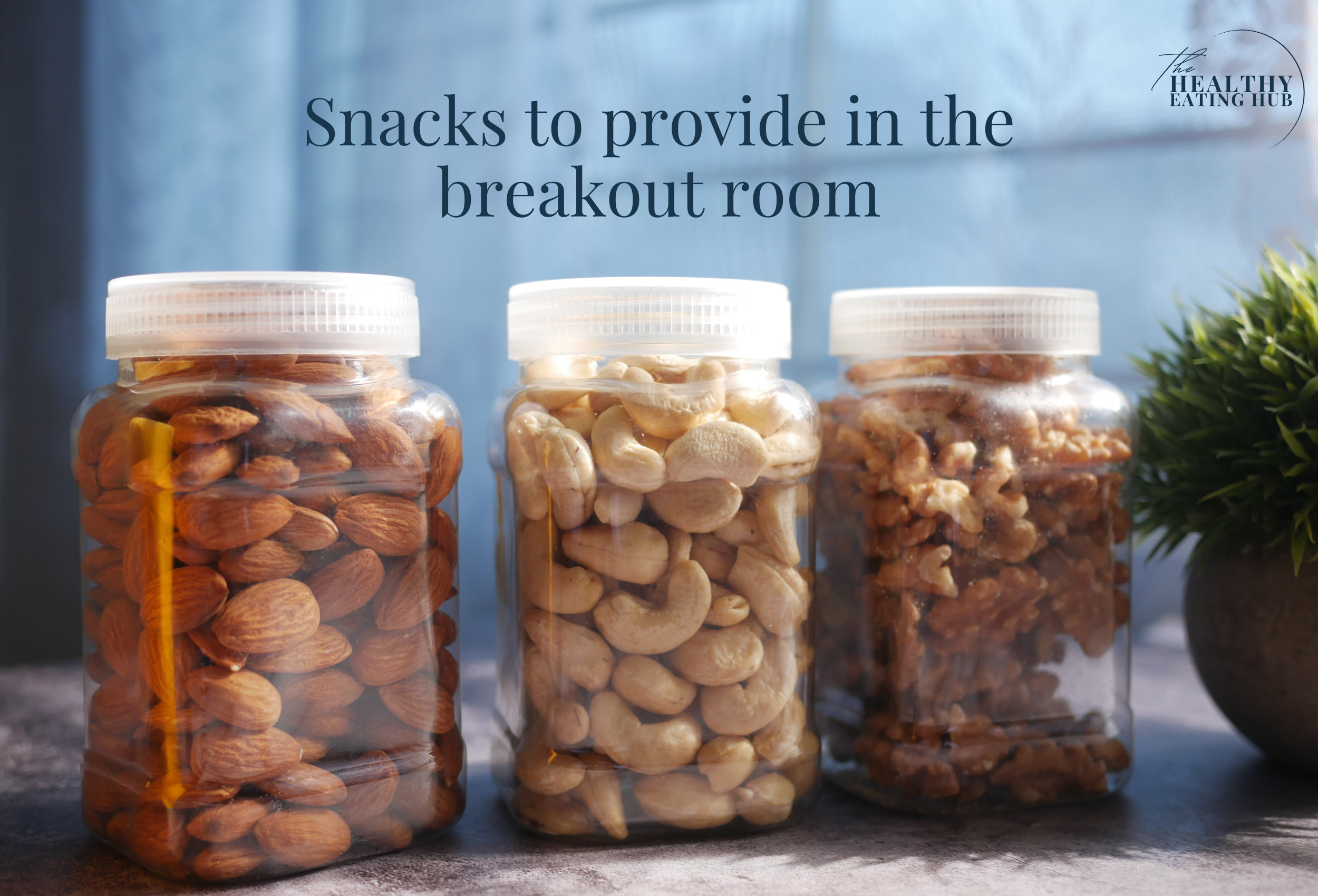
- Boxes of nuts
- Cheese and crackers (for the fridge, label it with your name!)
- Packets of rice crackers
- Packets of popcorn.
It might feel weird to have a mini pantry in your desk drawer, but trust me, you’ll thank yourself later. You might also inspire your team to do the same!
Order something healthy
The age of online food ordering means that you can get a vegetable-rich meal delivered straight to you. This could be as a lunch option, when you unexpectedly need to work later than usual, or even for catered meetings with your team. You could try:
- A burrito bowl
- Sushi
- Thai beef salad
- Rice paper rolls.
Give yourself a buffer
At work, you’re a decision-making machine! It’s no wonder your brain puts a few functions on autopilot so that you can get through the day. One of those functions is food choice. This means you can walk away from a food situation and have no idea what you chose and why you chose it. Sometimes, this works in your favour. Depending on how your autopilot is set up though, this could leave you regretting the choice.
The best thing you can do to switch off the autopilot is to give your brain a break before a food decision. To do this:
- Go to the bathroom before joining the work morning tea
- Take a walk before you buy your lunch
- Take 2-3 deep breaths before eating your packed lunch.
This can give you enough time to decompress a little and set an intention for what decision you’re going to make in the next situation.
Never complain, never explain
Eating in social situations if fraught with discussions about our food choice. While it’s great to connect with our colleagues over shared food, I find that it can be a minefield of options and pressure.
So, I have taken a page out of Her Majesty’s playbook and recommend ditching the desire to tell people why you are making your choice (healthy or “unhealthy”).
“Never complain. Never explain.”
YOU are doing YOU.
You’re not trying to wage a crusade against unhealthy eating. That’s Jamie Oliver’s job. You don’t owe anyone an explanation as to why you’re saying “no, thank you” to the platter of TimTams.
Say: “no, thank you”.
Avoid following it up with “I’m trying to be good” or “I don’t like TimTams”. Not just because that’s a lie, but because that invites further conversation about the food. Then the focus is all on food and it can start to feel like pressure to say “yes” to something you had already decided you didn’t want.
Plus “I’m trying to be good” can be countered with “you don’t need to worry”, or “one won’t hurt”, or “that’s no fun”, or you will get someone else’s justification for why they’re saying yes.
And “I don’t like TimTams” can get countered with “WHAT? Are you crazy?” or “would you like a cupcake instead?”
Going back to leading by example for a moment, all this also shows your team that they need to justify their own food decisions, eroding the health and safety of the work environment (more on that here).
So instead, be pleasant, smile and say “no, thank you.” That’s all.
Some people might press a little more and ask, “are you sure?” or “why not?” To this I would recommend KEEP CALM AND CARRY ON not explaining.
You could say, “I’m sure. Thank you so much for offering” or “I’m just not feeling like it right now. Thanks anyway”. But ultimately, you have set your boundary and they should accept it.
Want to empower your team to make their own improvements to their health, with the flow on effect of a more productive workforce? Our Employee Nutrition Program is what your workplace needs.