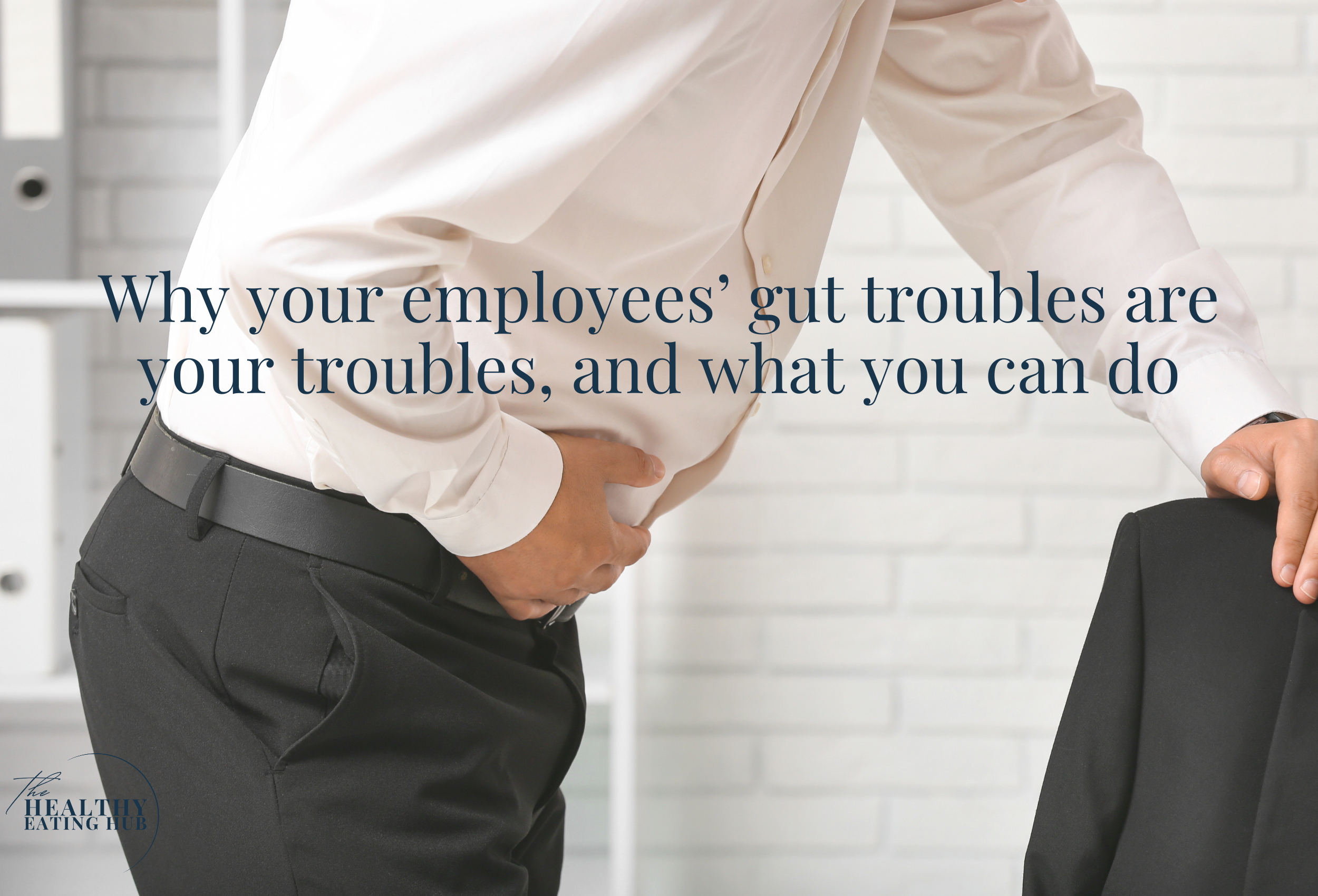
Toilet talk is something usually best left out of workplace conversations (unless you’re a dietitian, nurse or plumber!). But while our staff don’t tend to discuss their number twos with us, there is a high chance that what’s going on in their guts is negatively impacting on their work. This is because more than a third of Australians experience gut troubles1, and chances are some of those people work for you.
A recent study showed that 38.67% of Australians met criteria for at least one disorder of gut–brain interaction.1
The common disorder of gut–brain interaction you might have heard of is irritable bowel syndrome (IBS). While IBS isn’t the only gut issue that can get in the way of work, it certainly is a problematic one. People suffering from IBS report not wanting to leave the house, difficulty concentrating, and feeling self-conscious.2 A study looking into IBS and its impact on daily activities found that IBS symptoms caused people to miss around one and a half days of work per month.2 Further to this, and possibly even more problematic for employers, IBS symptoms were found to affect productivity at work eight days a month on average.2 That’s around 40% of the time!
Left untreated, we’re looking at weeks of lost productivity over the workforce.
In comes the ENP
Most workplaces these days will offer their employees an Employee Assistance Program (EAP) for their mental health. The benefits of EAPs are well known: reduced psychosocial risks, reduced absenteeism, improved retention.
Our ENP – Employee Nutrition Program – is a similar offering, but for nutrition. It involves employees getting one-on-one support with an Accredited Practising Dietitian. This support is tailored to the individual and their needs, taking into consideration their health issues, wellbeing goals, and work situation. In the case of gut troubles, it is vital that an individualised approach is taken as there is no one-size-fits-all. This isn’t about taking a medicine and moving on with your day. Improving gut symptoms often takes a multi-pronged, detective-like approach to identify the issue (or issues) and the best pathway forward. Our specialist gut health dietitians are well equipped to get to the bottom of what’s going on, helping to reduce employees’ symptoms. A reduction in symptoms can increase concentration, reduce the amount of time an employee spends away from work – whether that be out of the office or in the office but away from their tasks – and, ultimately, increase productivity.
Other benefits of our ENP
For the business, further benefits include:
- Increased employee engagement
- Increased morale
- A healthier workforce, thus a decrease in the incidence of absenteeism
- Employees that feel supported and are therefore incentivised to join or stay with the company
- Improving the business brand and enhancing company reputation
For employees, further benefits include:
- Improvement in health and prevention of diet-related disease
- More confidence in making food decisions
- Less food stress
The bottom line
Investing in your employees’ health through their nutrition is an excellent way to boost productivity and increase your bottom line.
Ready to offer the ENP to your employees?
References:
- Knowles SR, Apputhurai P, Palsson OS, Bangdiwala S, Sperber AD, Mikocka-Walus A. The epidemiology and psychological comorbidity of disorders of gut–brain interaction in Australia: Results from the Rome Foundation Global Epidemiology Study. Neurogastroenterology & Motility. 2023; 35:e14594. doi:1111/nmo.14594
- Ballou S, McMahon C, Lee HN, Katon J, Shin A, Rangan V, Singh P, Nee J, Camilleri M, Lembo A, Iturrino J. Effects of Irritable Bowel Syndrome on Daily Activities Vary Among Subtypes Based on Results From the IBS in America Survey. Clin Gastroenterol Hepatol. 2019 Nov;17(12):2471-2478.e3. doi: 10.1016/j.cgh.2019.08.016. Epub 2019 Aug 13. PMID: 31419572; PMCID: PMC7675784.